
Il Gladio Mondiale: Part 4
Ukraine or Little Russia

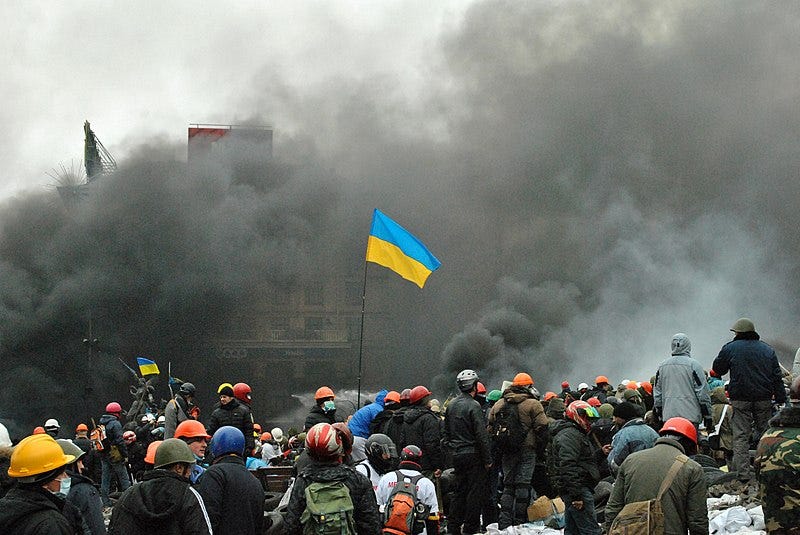
Protest at Maidan Square, February 20, 2014. Photo by Mykola Vasylechko under Creative Commons BY-SA 4.0.
The conflict between Ukraine and Russia has deep roots extending for hundreds of years and erupted most recently in the civil war in Ukraine in 2014. It has since crystallized into a status quo of the two breakaway republics of Donetsk and Luhansk propped up by Russia and the annexation of Crimea. It is in this milieu that we find the most active affiliates of the Atomwaffen Division: the Azov Battalion and Right Sector. Even in the most conservative approach to this conflict, there is a substantial amount of history required to understand its roots. The county is split roughly into a Europhile, Ukrainophone West and a Soviet-nostalgic, Russophone East. While the West is more profitable thanks to its financial sector, the East is far more mineral-rich.
December 1991: A referendum is held to support the Act of Declaration of Independence issued by the Ukrainian Parliament. In Crimea, where the turnout was the lowest in the country, only 54% of the votes were pro-Independence. Only 55% of all ethnic Russians living in the Ukrainian SSR voted for independence.
1994: Leonid Kuchma is elected President of Ukraine. He promotes Ukrainian as the language of public communication while keeping Russian as a second official language.
1999: Leonid Kuchma faces reelection, presenting himself as a pro-Ukrainian and democratic alternative to the Communist Petro Simonenko.
2004: Acting Prime Minister, oligarch, and former governor of Donetsk, Viktor Yanukovych opposes Victor Yushchenko in the Presidential elections. Yushchenko’s Nasha Ukraina supports European integration, NATO membership, and anti-corruption. Yanukovych’s Party of Regions appeals to voters in the Russophile East by labelling his opposition as the party of Ukrainian nationalism. The election goes to a run-off, won by Yanukovych.
2004-2005: The Orange Revolution takes place following accusations of corruption, intimidation, and fraud in the 2004 election. The Ukrainian Supreme Court orders a revote, which is won by Yushchenko.
2005-2010: Yushchenko’s presidency seeks to rehabilitate Ukrainian nationalism and to distance itself from Russia. In January 2010, a Ukrainian court ruled on the criminal responsibility of the Soviet leadership for the Holodomor, the famines of 1932-1933 that killed millions. This antagonized Russia, who rejected the definition of the Holodomor as an intentional act. In the same month, Yushchenko posthumously awards the Star of Hero of Ukraine to Stepan Bandera, the leader of the Ukrainian Insurgent Army (UPA) which has been accused of collaboration with Nazi Germany to commit ethnic cleansing against Jews and Poles. This was denounced by the European Parliament, as well as Russian, Polish, and Israeli politicians, and alienated Ukrainians who disagreed with the heroization of the UPA.
2010: The Party of Regions and Yanukovych position themselves as an anti-Fascist force protecting the Russphone east from the threat of radical Ukrainian nationalism. Yanukovych wins the Presidential election, allows a Donetsk regional court to rescind the posthumous award, and refuses to refer to the Holodomor as a genocide.
2012: The Party of Regions passes the law, “On the Principles of State Language Policy”, giving Russian the status of a regional language, and approved its use in courts, schools, and other government institutions where national minorities exceeded 10% of the local population. The radical nationalist Svoboda party enters the parliament from western Ukrainian constituencies with 37 MPs after sanitizing its rhetoric.
November 21, 2013: The government postpones signature of the planned EU-Ukrainian Association Agreement following the start of a Russian trade war, subsequent negotiations for compensation from the EU for the loss of trade from the East, and concerns over the terms of the IMF loan and the major changes to Ukrainian law required by the EU. Overnight, protestors rally at the Maidan Nezalezhnosti (Independence Square, or Maidan) in response.
November 30, 2013: The Berkut (riot police) attack protestors at the Maidan, and the Right Sector, mostly anti-establishment far-right activists and football hooligans, organize training on how to counter police attacks.
December 1, 2013: Andrii Parubiy begins organizing the Maidan Self-Defense and mass rallies begin. The Kiev City State Administration and Trade Union House are captured, and protestors attempt to break police and Berkut lines at Bankova street to capture the Presidential Administration. Berkut routs the protesters and beat everyone in sight.
December 2-January 15: Mass protests continue with intermittent skirmishes. On December 8, radical Right activists tear down the Lenin monument on Shevchenko Boulevard. On December 10-11, police cut power to protester-held buildings and unsuccessfully attempted to rout protesters from the Kiev City Hall and the Maidan. Radical Right protesters continue to clash with Left protesters.
January 16, 2014: The government passes a series of laws prohibiting protests.
January 19, 2014: AutoMaidan, mostly taxi drivers and people with cars, confront police at Hrushevsky Street, where protesters, including the Right Sector, attempt to break police lines. Over the following days of protests, four protesters are killed.
January 20-February 16: Right Sector and other Self-Defense units confront police, Berkut, and hired titushki. Activists begin to face kidnappings, torture, and murder. On January 28, Prime Minister Azarov resigns and the government attempts to negotiate a truce with the protestors. The US is accused by Russia and the Ukrainian government of supporting militancy in the protest movement. Anti-Maidan groups begin to appear and scuffle with Euromaidan protesters.
February 17: Government passes “Law on Amnesty of Ukrainian protesters” predicated on the vacation of seized government buildings and the unblocking of major streets.
February 18-20: Protestors are attacked by Berkut on rooftops with stun grenades and shooting, killing ten. Clashes in Mariinskyi Park, Hrushevsky Street, and Institutska Street erupt, leading to hundreds injured. Police storm the Maidan overnight, and on February 20 begin attacking protestors with sniper rifles, killing over 100.
February 21: Maidan rejects the government deal, and Yanukovych and many government ministers flee overnight.
February 22: Parliament forms an interim government under acting President Turchynov and reverts to the 2004 Constitution, supported by the Maidan movement. Western leaders recognize this new government as legitimate; Russia denounces it.
February 27: Russian special forces capture the Supreme Council of Crimea, and a new government is installed under Sergey Aksyonov.
March 2014: Regional elites oppose the new government; separatist and pro-Russian mass protests erupt in Kharkiv, Luhansk, and Donetsk. Police and Berkut defect to regional elites in the East, while Crimea holds a “referendum”, announcing a 99% vote to declare independence from Ukraine and to join Russia. Two days later, Russia formally annexes Crimea. In response to the ouster of Ukrainian control, the National Guard is established and volunteer battalions form.
April 2014: Pro-Russian activists storm the SBU offices in Donetsk and Luhansk, systematically routing government forces. On April 15, acting President Olexander Turchynov declares the start of anti-terrorist operations and deploys the Ukrainian military to the East. On April 27, separatists in Luhansk declare the formation of the Luhansk People’s Republic.
May 2014: The Ukrainian army attempts to retake Sloviansk while separatists attempt to capture Mariupol. Referenda held in Donetsk and Luhansk are announced, with the Donetsk and Luhansk People’s Republics announcing their independence. Separatists capture the Donetsk airport and are forced to retreat under airstrikes from the Ukrainian military. Separatists begin shelling government positions and capture Debal’tseve, a major rail and communications hub in the East. Petro Poroshenko is elected as President, while pro-Russian protesters attack a pro-Ukrainian rally in Odessa. The pro-Russians are routed, and their camp at Kulikovo Pole is set on fire. Protestors seeking refuge in the Trade Union House are trapped inside and killed after the building catches fire, killing 48 people.
June 2014: The Ukrainian military takes control of Mariupol and attempts to encircle separatists by controlling the Russian-Ukrainian border.
July 2014: Separatists are routed from Artemivsk, Sloviansk, and Debal’tseve, and retreat to lay siege to Ukrainian forces at the Luhansk airport. Malaysian Airlines Flight MH17 is brought down by a surface-to-air missile over Donetsk, killing nearly 300. Both the Ukrainians and the Russian-backed separatists deny responsibility.
August 2014: Ukrainian forces retreat from the Russian border under heavy shelling and rocket fire. Donetsk and Luhansk are split due to government control of Debal’tseve, but separatists maintain control of Ilovaisk and capture Novoazovsk. When government forces begin to make footholds in Ilovaisk, they immediately come under siege; during a negotiated retreat they come under heavy fire from separatists. Ukraine has claimed that the separatists broke their word; the separatists claimed that Ukrainian forces violated the terms of the retreat by attempting to leave with heavy weaponry.
September 2014: The Ukrainian Minister of Defense, Valeriy Geletey, declares that the situation in the East is a full-scale Russian invasion amid the capture of Luhansk airport and the separatist siege of Donetsk airport. On September 5, the Minsk I ceasefire was signed and nearly immediately broken as separatists assault Mariupol.
October-December 2014: Separatists capture Smile and begin to encircle Debal’tseve. In November, Russia announced that it would no longer participate in the annual US-Russian nuclear security summit, and in December terminated the Nunn-Lugar Act agreement in which the US assisted Russia to dismantle previously decommissioned nuclear weapons. Russia begins to carry out military exercises with nuclear-capable weapons. On Christmas Eve, the Minsk II ceasefire is signed, beginning the process of POW exchange between Ukraine and the separatists.
January 2015: Separatist forces capture Donetsk airport and begin shelling Ukrainian positions in Debal’steve.
February 2015: Separatist forces capture Debal’tseve.
March 2015: Separatists forces begin attacking Shyrokyne.
July 2015: Russian-backed Separatists fail to capture Shyrokyne and begin attacking Stanitsya Luhanska. The Minsk II agreement is largely ignored at this point.
August 2015: Separatist forces attempt to capture Mariupol.
September 2015: The Minsk II ceasefire is renewed by members of the Trilateral Contact Group, including Russia, Ukraine, and the Organization for Security and Cooperation in Europe (OSCE). Conflict lines “freeze”, with intermittent skirmishes.
January 2018: The Ukrainian parliament passes a resolution to regain control over the separatists-held areas.
April 2018: The Anti-Terrorist Operations are replaced by a Joint Force Operation as the US sends Javelin missiles to Ukraine.
December 2019: Both sides agree to disengage forces in three areas: Stanytsia Luhanska, Zolote, and Petrovske. This successfully reduces the intensity of skirmishes in Stanytsia Luhanska and Zolote.
2021: Russian forces mass in Crimea and on the Russian border, marking the largest troop surge since 2014. As of December 2021, there are an estimated 200,000 Russian troops.
For many years, Ukraine has been an intersection between the European West and the Slavic East. Since the independence of Ukraine from the Soviet Union, there has been a political project to reimagine Ukrainian history and the Ukrainian nation as the history and people of ethnic Ukrainians and Ukrainophones. This project has not been complete, however: about one third of the population identifies themselves as Russophone Ukrainians and ethnic Russians do not feel pressured to assimilate.
Yushchenko saw Ukraine as a post-colonial nation struggling to free itself from Russian influence. At the same time, Russian intellectuals were developing the concept of Russkiy mir, or “Russian world”, signifying the idea that “Russia is wherever Russians are.” This originally referred to the Russian diaspore, but came to signify a supranational Slavic-Orthodox civilization. Russkiy mir was a project to counter the spread of Western values in the Slavic East, appealing to traditional values and “normality”. The appeal of Europe lies in its wealth, rule of law, respect for human rights, and tolerance. By contrast, the appeal of Russkiy mir is in common cultural values and historical memory, mixed with a skepticism of European Enlightenment values.
Western NGOs have operated in Ukraine for many years, and they have come to view themselves as the bleeding edge in the transition to democracy. Indeed, as Rasari Puglisi writes for the Instituto Affari Internazionali in “A People’s Army”, there has been a persistent dearth in citizen participation in and donorship to NGOs in Ukraine. Even for the Euromaidan, it was not until Yanukovych’s government began to violently repress the student protests that the movement gained massive support. These are opposed by Russian think tanks, called government-organized NGOs (GONGOs) in Western media, which support Russian control in Crimea and promote Russian values.
Of course, we must understand that the battle of NGOs in Ukraine is a battle of Western versus Russian culture. The actions of the Western NGOs, the EU, NATO, and the US in Ukraine have been to install democracy, which reveals a fundamental desire to elevate equality as the utmost good. By contrast, Russian influence, insofar as it exceeds the mere strategic advantage of Russia, aims to gather together the scattered Slavic peoples into a unified entity to reignite the Slavic civilization. In that sense, the goal of the Russian project is glorification, to the detriment of individual equality.
Ukraine, for its own sake, has had a long history of suffering under foreign powers. Kievan Rus had been under foreign domination since the 1300s when it became controlled by Poland and Lithuania, then the Crimean Khanate in the 1500s, and Russia in the 1600s. It enjoyed self-rule briefly under the Cossacks and the Ukrainian People’s Republic, but was conquered by the Bolsheviks in 1921 and suffered terribly under the Holodomor of 1932-1933. In 1942, the Ukrainian Insurgent Army arose, collaborating with Nazi Germany to expel the Soviets. In 1968, the Chernobyl Nuclear Power Plant exploded, resulting in the estimated death of 4000 people across Ukraine, Belarus, and Russia over the years to come, the radioactive contamination of 2800 square kilometers (1100 square miles) of land sealed as the “Exclusion Zone”, and intensified distrust of the Soviet System and nuclear power by Ukrainians.
The passage of the decommunization laws by President Poroshenko in May 2015 naturally alienated the Soviet-nostalgic East. Law 2558 condemned the Communist regime and prohibited its symbols, including the removal of monuments, renaming of towns and streets, and the banning of Communist Parties. Law 2538-1 elevated the OUN and Ukrainian Insurgent Army to official veteran status and treatened those who insulted the militas with prosecution. Law 3539 recognized the “victory over Nazism” in the Second World War, not the Soviet phrasing of the “Great Patriotic War”. law 2540 opened access to the Communist archives. There has been little public support for these laws, but the Ukrainians in the West seem to oppose it for economic, over political reasons, according to Oxana Shevel writing in PONARS Eurasia in January 2016.
When the Soviet Union dissolved in 1991, Ukraine was elated at the chance to escape Russian domination. They had been left 726,000 military units and the third-largest nuclear arsenal in the world, but agreed to join the Treaty on the Non-Proliferation of Nuclear Weapons. They turned over their nuclear arsenal to Russia and promptly allowed their military to become small, derelict, and corrupt under the dubious security assurances of the “non-legally binding” Budapest Memorandum. By 2000, only 30% of its weapons platforms (aircraft, helicopters, air-defense systems, and ships) were operational; 40-50% were obsolete. Soldiers and middle-ranking officers were frequently impoverished and demoralized; top officials enjoyed a system of patronage and revenue from the Army’s real estate property. During the Yanukovych presidency, senior military officials were appointed for political loyalty, rather than competence.
The Russian annexation of Crimea was a heavy blow, with 12,000 Navy personnel defecting and the loss of 51 vessels. By the time of the civil war, only 6,000 troops were combat ready.. During initial hostilities, some units of the regular army defected to the separatists, while others were disarmed and disbanded with little resistance. Volunteer battalions prevented Mariupol from falling to the separatists, but the Ministry of Defense was unable to provide weapons, armor, or even food and water to all units. It required voluntary donations, the selling of war bonds, and the support of regional oligarchs to stop the Separatist advance. Indeed, the volunteer battalions were better equipped and paid than the regular army thanks to oligarchs like Igor Kolomoisky, former governor of Dnipropetrovsk, who financed the Dnipro-1, Donbas, and Azov Battalions, as well as the Ukrainian Volunteer Corps.
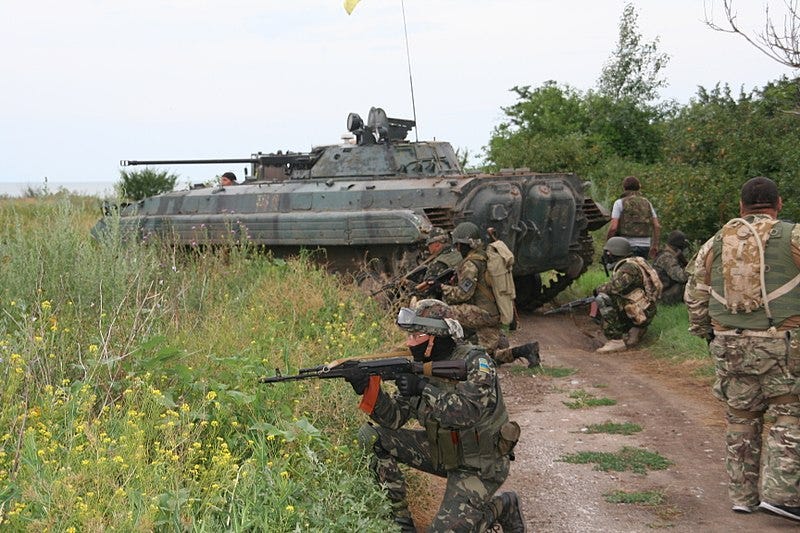
Soldiers from Azov Battalion in position. Photo by Carl Ridderstrale under Creative Commons BY-SA 4.0.
The volunteer battalions received manpower from the sotnyas of the Maidan Self-Defense, including the Svoboda 2nd Sotnya, which became the Sich Battalion, and the Right Sector 23rd Sotnya, which became the Ukrainian Volunteer Corps and Azov Battalion. While most of the volunteers were not made of radical right groups, prominent battalions like the Azov Battalion, Aidar Battalion, UVC, and Battalion OUN (Organization of Ukrainian Nationalists) were. The most radical ones were fiercely critical of the Ukrainian government and have been accused of war crimes. Out of the 30 major volunteer battalions, 12 were accused of inappropriate activities, and Huseyn Aliyer, writing for Security Dialogue in “Strong Militias, Weak States, and Armed Violence” notes that these state-parallel militias were often keen to target elements of the population associated with the pro-Russian separatists. Though Aliyer does not say so explicitly, this would tend to drift into ethnic cleansing activities of the sort observed in the Balkans and of ethnic Germans in the post-World War II East.
American foreign policy is predicated on dumping money on a situation to get a specific outcome. Since 2014, America has pledged over $1.5 billion in security assistance and $3 billion in loan guarantees, including training from the 173rd Airborne in Operation Fearless Guardian, police training, humanitarian aid, military advisement, weaponry (including Javelin anti-tank missiles, anti-artillery radar, air and coastal defense), and anti-corruption programs. President Obama issued sanctions on Russia and connected individuals and firms, worked to eject Russia from the G8, and was instrumental in convincing the EU to maintain sanctions against Russia. Putting aside the morality of imposing sanctions, they clearly did not stop Russia from installing what Western observers have described as puppet states in the Donbas. As Philip Karber of the Potomac Foundation asserts, Russian superior artillery, missile, electronic warfare, drones, tanks, and the use of Special Forces, coupled with Obama’s reluctance to support Ukraine, ensured Russian success.
While President Obama was reluctant to send lethal aid to Ukraine, President Trump reversed this policy with the sale of Javelin missile systems to the Ukrainian military. This relationship became a flashpoint in 2019 when it was revealed that Trump has threatened to withhold military aid to Ukraine over allegations of corruption at the natural gas company, Burisma. Because these allegations implicated Hunter Biden, the son of then Vice President Joe Biden, this incident became grounds for impeachment. This is not the first time that the US intervened in Ukraine over corruption: in 2015, the US spent $15 million to train Ukrainian police instructors and allow a total replacement of the country’s police force. Later that year, Biden announced that $190 million would be spent on anti-corruption reforms in Ukraine. That same year, Biden threatened to withhold $1 billion in aid (and the IMF did the same with $40 billion) over allegations that then Prosecutor General Viktor Shokin was turning a blind eye to corruption.
More recently, President Biden’s staff canceled a White House visit by Ukrainian President Zelensky over the ouster of Andriy Kobolyev as CEO of the state-owned energy company Naftogaz in April 2021. While Western observers have described this as a failure of Zelensky to uphold anti-corruption promises, reporting by Llewellyn King in Forbes alleged the operation of a series of convoluted corruption schemes perpetrated by regional oligarchs and permitted by Naftogaz officials. For example, Ukrnafta, majority-owned by Naftogaz but with 42% of its stock owned by the Kolomoisky’s Privat Group, is responsible for 91% of oil, 27% of natural gas, and 17% of petroleum gas extraction in Ukraine. Naftogaz buys gas from Ukrnafta at above-market rates to cover the latter’s tax debt, the Ministry of Energy compensates Naftogaz, and Ukrnafta sells to other Kolomoisky companies at below-market rates to be resold to the power generation company Centrenergo for a tidy profit.
There are other reasons for Biden to be cross with Zelensky: Zelensky is vocally opposed to the Nord Stream 2 pipeline from Russia to Germany through the Baltic Sea; Biden has softened his position on it in the interest of closer ties with Germany. Of course, Nord Stream 2 is an existential threat to Ukraine: much of Ukraine’s economy is reliant on Russian gas, especially now that its gas reserves in the East and Crimea are unavailable to it. In the gas disputes of 2006 and 2009, when Russian Gazprom shut gas transmission to Ukraine, Russia was still dependent on Ukraine for 80% of its sale of gas to Europe. At the time, Ukrainian pipelines had by far the largest capacity of 160 bcm annually; Polish Yamal-Europe and Baltic Vyborg-Inatra lines counted for 33 bcm and 6 bcm annually, respectively. Compare that to the approximately 120 bcm annually that Russia provides to Europe.
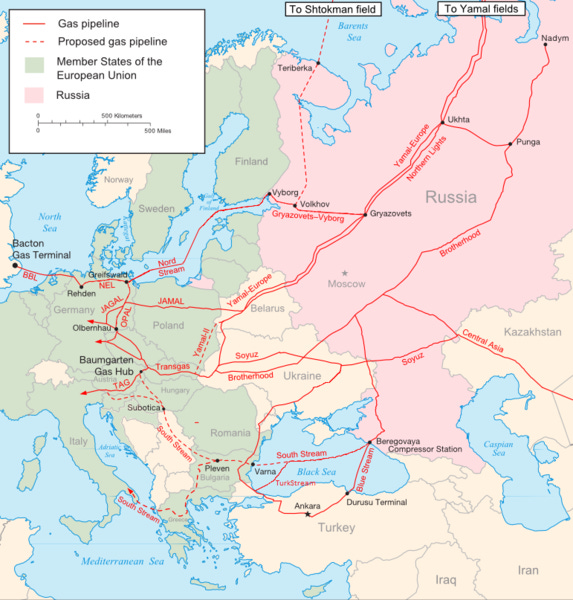
Major Russian-controlled gas pipelines to Europe. Map by Samuel Bailey under Creative Commons BY 3.0.
Since then, pipeline construction and planned construction have reduced the reliance on Ukraine. The Nord Stream pipeline, built in 2011, has a capacity of 55 bcm annually. TurkStream, built across the Black Sea to European Turkey, has a 31.5 bcm annual capacity, delivering gas to Bulgaria via the Trans-Balkan pipeline and on from there to Serbia and Hungary. The proposed Tesla pipeline would extend TurkStream through Greece, up the Balkans, and eventually into Austria, carrying 27 bcm annually. The Yamal II pipeline would allow gas from Yamal-Europe to bypass Ukrainian lines into Slovakia and thence to Central and Western Europe, with a 15 bcm annual capacity. Once Nord Stream 2 is complete, it will carry an additional 55 bcm annually to Germany. In 2009, Russia was dependent on Ukraine; when Nord Stream 2 is complete, it won’t be.
Once the contract between Gazprom and Naftogaz expires in 2024, any further gas transit from Russia and Ukraine will gain new geopolitical significance, and provide an avenue for Russia to pressure Ukraine. This is why Trump signed legislation in 2019 to sanction businesses involved in the Nord Stream 2 project. When Biden came into office, despite his and Secretary of State Blinken’s state opposition, the State Department began waiving sanctions in May 2021 and in June Biden announced that the US would no longer oppose construction. That same month, Biden paused $100 million in military aid ahead of a summit with Putin to re-normalize diplomatic relations and urged Ukraine not to publicly oppose US-German plans to support the construction.
This vignette reveals the schizophrenic nature of US foreign policy: overbearing when it needs a light touch, aloof when it needs to be engaged, and often capricious. Worse, like the “moderate rebels” in Libya and Syria, the US, and especially the Pentagon, have not been particularly discerning in their selection of allies. In June 2015, the US Congress passed a resolution to block support of the Azov Battalion. The Pentagon lobbied the House Defense Appropriations Committee to remove the amendment from the 2016 Defense Budget. Once again, the US has inserted itself into another country’s civil war (which it may have been instrumental in sparking, as Russia claims was the purpose of former CIA Director John Brennan’s April 2014 visit) to assert that democracy is the answer, and whoever opposes the American enemy is a friend.
Much like the tolerance of the US to the opium trade and pederasty in Afghanistan, the US has largely turned a blind eye to American actors cooperating with National Socialist battalions in the Donbas. Even in denouncing the Atomwaffen Division, it was to assert dubious links to Russian extremism which were either long defunct (in the case of Iron March) or which opposed AWD’s allies in Ukraine (in the case of the Russian Imperial Movement). By contrast, it is believed that AWD Galizien (aka AWD Fission, composed of former mainline AWD members) was operating in the Carpatians with the Sich and Azov Battalions, as well as the UVC. Nathaniel D. Palmer (“Ironclad”, AWD Wisconsin) was a recruiter for the Azov battalion on Iron March. Jarrett Smith was a member of the Misanthropic Division, which was a part of Right Sector in the Euromaidan and joined the Azov Battalion. AWD Europe, subsidiary of AWD Deutschland, was tied to the Misantropic Divisions, and members attended Azov training camps. In 2019, AWD, SKD, and Azov members met with the FKD and Estonian MP Ruuben Kaalep, according to the Estonian Public Broadcasting.
It should not be surprising, as both AWD and the Right Sector follow revolutionary National Socialism-it is only that AWD’s version is more hardcore. On the other hand, while Right Sector has not been as ideologically extreme, they have been more active and lethal, as well as actually militarized. It is unclear how Mason would view the connection. On one hand, the volunteer battalions are nationalistic, anti-Europe, and support the AWD with military training. On the other hand, the strategic result of the volunteer battalions has been to ensure the transfer of Ukraine to the European, and thus American, sphere of influence. In either case, we can view this connection as a crucial step in the militarization of the AWD, with the complicity of the Western establishment.
In the next section of Il Gladio Mondiale, we return to the Atlantic with an examination of the individuals behind the Satanic “religion” adopted by the Atomwaffen Divison: Joshua Caleb Sutter’s Tempel ov Blood in the United States and David Myatt’s Order of Nine Angles in the UK.
Sign up now to be notified of every edition of Saving Face, a historical account of the misdeeds of the Western World. With hindsight, we can look back on their mistakes, and hope to avoid repeating them. Our power can’t last forever, but the fall doesn’t have to be hard.
For more resources into the conflict in the Donbas, consider:
Tatiana Zhurzhenko. A Divided Nation? Reconsidering the Role of Identity Politics in the Ukraine Crisis. Die Friedens-Warte, volume 89. 2014.
Rosaria Puglisi. General Zhukov and the Cyborgs: A Clash of Civilization within the Ukrainian Armed Forces. Instituto Affari Internazionali. May 2015.
Rosaria Puglisi. A People’s Army: Civil Society as a Security Advisor in Post-Maidan Ukraine. Instituto Affari Internazionali. July 2015.
Vyacheslav Likhachev. The “Right Sector” and Others. Communist and Post-Communist Studies. June/September 2015.
Michael Komin, Alexander Vileykis. ‘Good’ and ‘Bad’ Investments: Everything You Always Wanted to Know about Ukrainian Commanders but were Afraid to Ask. Connections QJ. Winter 2016.
Huseyn Aliyev. Strong Militias, Weak States, and Armed Violence. Security Dialogue. December 2016.
Philip Karber. Russian Operations in Ukraine’s War. West Point, Modern War Institute Symposia. April 3, 2017. (video)
Jesse Driscoll. Ukraine’s Civil War. OSU Mershon Center. September 13, 2017. (video)
For more resources on the links between Ukraine, the US, and corruption, consider:
Chi-Kong Chyong. The role of Russian gas in Ukraine. European Council on Foreign Relations. April 16, 2014.
Todd Prince. Ukraine’s ‘Internal Threat’ on Blinken’s Plate after Naftogaz CEO Fired. Radio Free Europe/ Radio Liberty. May 4, 2021.
Jonathan Swan, Dave Lawler. Exclusive: Zelensky “surprised” and “disappointed” by Biden pipeline move. Axios. June 6, 2021.
Betsy Woodruff Swan, Alexander War, Andrew Desiderio. U.S. urges Ukraine to stay quiet on Russian pipeline. Politico. July 20, 2021.
Dave Lawler. Congress, Europeans trash pipeline deal. Axios. July 22, 2021.
Llewellyn King. Past Corruption Overshadows Ukraine’s Oil and Gas Industry. Forbes. August 27, 2021.